
Buffalo Grove Previous Resident Sources
A Buffalo Grove address history begins in the county parcel file, then moves through deeds and dated sources that may identify occupants. Lake and Cook County have different online cutoffs. A modern owner name is only a starting point. Telephone books capture subscribers, census schedules capture households at an enumeration date, and newspapers or probate files may explain a move or transfer. The table separates each source by era and evidentiary value.
| Source | Years It Covers | Where Held | What It Shows |
|---|---|---|---|
| County deed indexes | Lake online 1980-present; Cook online described as 1985-present | Lake Recording Division; Cook County Clerk Recordings | Grantors, grantees, document dates, numbers, and legal descriptions |
| Older deed books | Lake recording since 1844; Cook historic holdings back to 1871 | Index books, county counters, CARO, and IRAD | Earlier transfers when the current web index stops |
| Regional White Pages | 1960/61, 1961/62, 1962/63, 1964/65; related 1966-68 metadata | Library of Congress and library access | Listed subscriber, address, and telephone snapshot |
| Federal census | Public schedules through 1950 under the 72-year rule | NARA, FamilySearch, and library databases | Household members, ages, birthplaces, and location context |
| Local context | Dates vary by collection | Village files, Raupp Museum, libraries, and IRAD | Permits, newspapers, probate, photos, receipts, and historical names |
For a recent sale, use the assessor and recorder first. For a mid-century household, compare the deed trail with the regional telephone editions and the census. Earlier work often shifts to legal descriptions, county books, probate, newspapers, and archive staff. Buffalo Grove incorporated in 1958, so pre-incorporation evidence may sit under county or township geography rather than a modern village address.
Start Buffalo Grove Address History
Confirm the county before searching names. The Buffalo Grove Community GIS Portal accepts a street address and provides Property Summary, Government Representatives, Zoning Information, Map Gallery, and Property Tax Breakdown tabs. The legal ownership record comes from Lake or Cook County. Capture the PIN, township, tax year, situs address, billing name, and legal description from the proper county system.
Situs means the physical property location. A tax mailing address is where correspondence goes, and it can belong to an agent, trust, or owner elsewhere. The legal description identifies the land by subdivision, lot, block, or metes and bounds. That description can survive a street-label change, making it the strongest bridge between modern and old deeds.
The Lake County sample conveyance view shows how parcel history is presented.
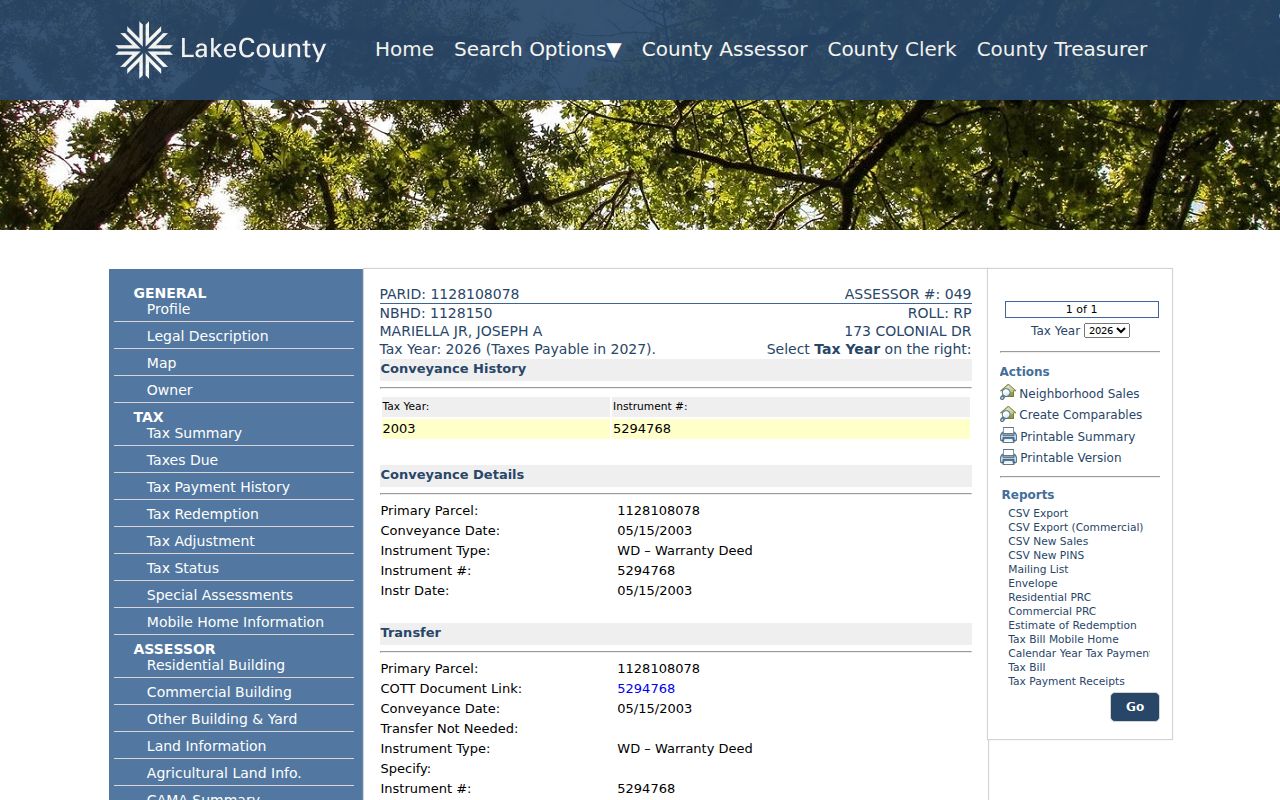
The visible conveyance rows connect instrument type, document number, recorded date, grantor, grantee, and consideration to one parcel, which gives the recorder search a precise starting point.
Two Counties, Two Resident Trails
Buffalo Grove occupies both Lake and Cook Counties. One village name therefore leads to two assessor systems, two recording routes, and separate historical repositories. Lake County's web index reaches from 1980 forward, while its handwritten Online Index Books and counter terminals cover the earlier path. Cook County describes its database as 1985-present and its historic recordings as reaching back to 1871.
Cook County's recorder duties moved to the County Clerk on December 7, 2020. Older Cook research may also require the Cook County Historic Archives and Records Office, IRAD, or a Clerk inquiry. For Lake material, the Recording Division, handwritten books, county research centers, and the Northern Illinois University IRAD repository form the fallback chain. Never assume a result is absent until the correct county and offline channel have been checked.
Note: Online index dates mark search-system coverage, not the first year in which a parcel or family existed.
Trace Buffalo Grove Previous Owners
A deed chain follows each transfer in reverse order. Start with the current parcel rather than a person's name alone. The Lake County Public Record Search offers quick and advanced searches with a grantor or grantee term, date range, index or full-text scope, and document filters. Cook County parcels use the Cook County Clerk Recordings route. Confirm every candidate by document number and legal description.
- Copy the current PIN, owner or tax-bill name, and legal description from the assessor record.
- Find the current owner's purchase deed near the most recent conveyance date. Match the instrument number and land description.
- Read the seller as the prior grantor, then search that party as a grantee to locate the earlier purchase.
- Repeat while logging dates, document numbers, name variants, trusts, estates, and subdivision or lot references.
- When the web index ends, move to handwritten books, counter terminals, county archives, or IRAD.
- Grantor and grantee
- The grantor gives or transfers an interest. The grantee receives it.
- Chain of title
- The linked series of recorded transfers for the same parcel.
- Legal description
- The deed's formal land description, which can remain usable when a street address changes.
Lake Previous Residents Before 1980
Lake County's 1980 online cutover is a practical turning point, not a records-loss date. Pre-1980 documents are reached through separate handwritten Grantor and Grantee Online Index Books and office resources. The recorder has recorded documents since 1844. Its search pamphlet reports roughly seven million documents and twenty-one million pages, so a narrow name, date, and legal-description search matters.
The recorder does not perform a title search and does not guarantee that an online result is a complete title history. A trust name, initial, spelling shift, or changed deed description can hide the prior link. Search both grantor and grantee books, widen the date range, and ask staff which index or counter terminal covers the missing era.
The official Lake recorder index shows the current grantor-grantee search surface.
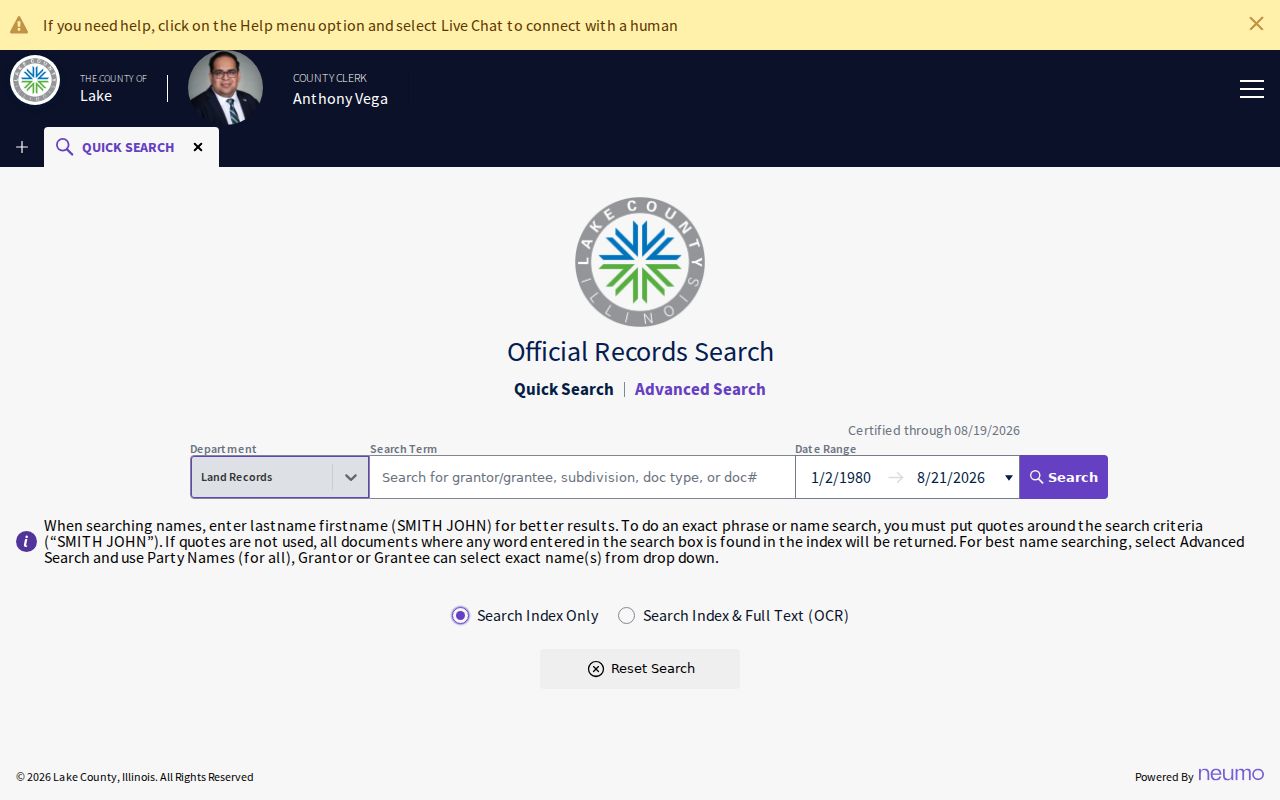
Its date and scope controls help isolate one transfer, but the image also underscores why older index books remain a separate access channel.
Deeds Do Not Prove Residents
A deed names parties to a land transaction. It does not list every person who lived at the property, prove that a buyer moved in, or establish continuous occupancy. The recording date may also come after the transaction. A seller's mailing address can be useful for a later search, but it remains a transaction address unless another dated record supports residence.
This distinction prevents a common house-history error. Owners and previous residents overlap only sometimes. Compare the chain with a dated telephone listing, census line, obituary, permit, tax exemption indicator, or newspaper notice. Keep each conclusion modest: “named as grantee” is stronger than “lived here,” and “listed subscriber at this address” is narrower than “complete household.”
Use records lawfully. Buffalo Grove address history supports family and property research. Never use it to monitor, intimidate, or harass a living person.
Buffalo Grove Property Context
Plats, zoning files, and permits can explain why an address appears, changes, or divides. Buffalo Grove's permit system uses BS&A with address, name, and parcel-number search routes, though live result pages were unavailable during research. A narrow Illinois FOIA request to the Village can seek a defined historical permit or subdivision file when the portal does not supply it. Mailed zoning verification is listed at $150 with about ten working days for response.
Sanborn fire-insurance maps can show building footprints and use in places they cover, but no verified Buffalo Grove Sanborn volume was found. The Library of Congress Sanborn research guide explains how to check state, city, edition date, sheet count, and place names.
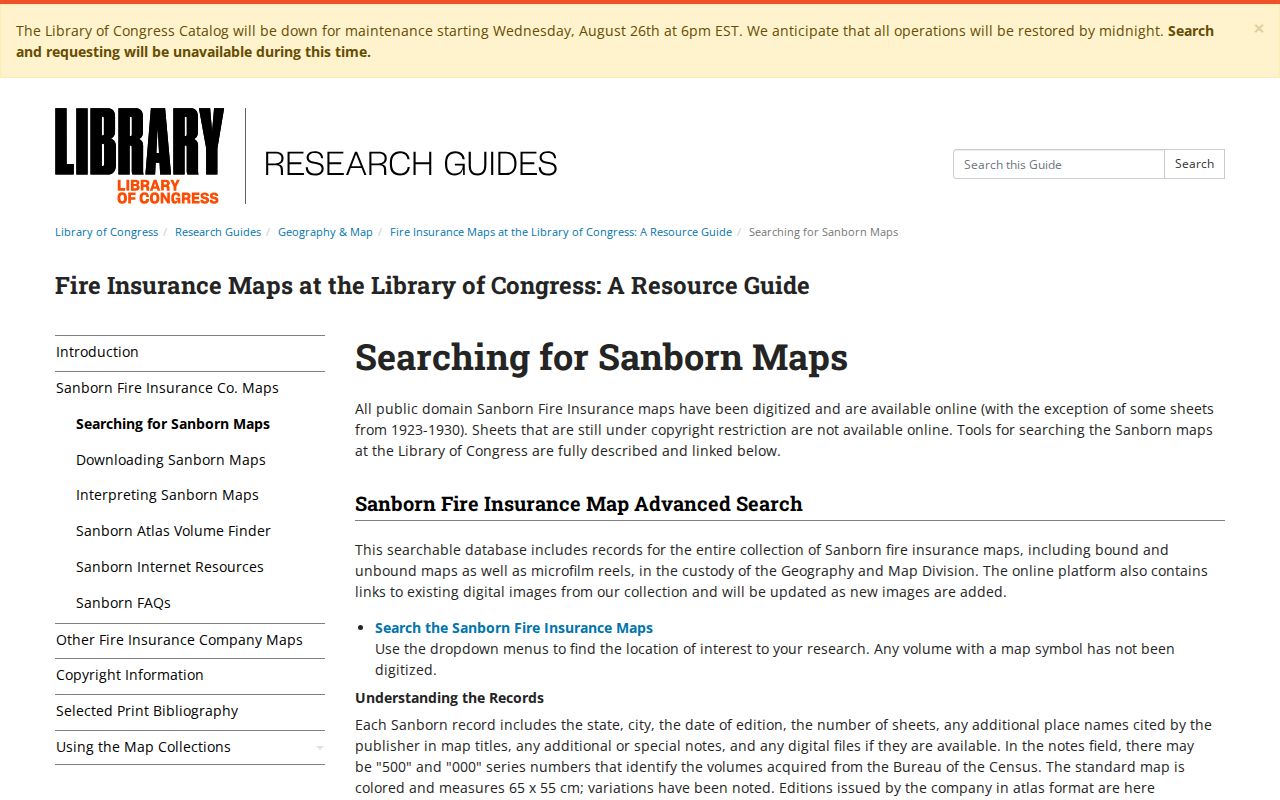
The guide is a search method, not proof that a local sheet exists. Use CookViewer historical parcel layers, plats, permits, and museum photographs when the map search remains empty.
Names Beyond Buffalo Grove Deeds
Raupp Museum preserves an unusually personal local trail. Its public collection identifies a Weidner's General Store receipt dated June 17, 1895 and a larger group of receipts from 1916 through 1919. A receipt can tie a name to a date, goods, and local business activity, though it is not a full customer roll and does not prove an address.
Those artifacts matter because the county record era predates Buffalo Grove's 1958 incorporation. Farm and road-era families may surface in receipts, county deeds, township materials, church or cemetery references, newspapers, and probate before they appear under a modern village street. Search the Raupp Museum online collections, then contact museum staff about supervised archival access when an object description points to a family or property.
Confirm Buffalo Grove Past Households
The verified Library of Congress Chicago Suburban North White Pages include Buffalo Grove in the locality index for several editions from the early 1960s. A listing may show a subscriber, address, and telephone number. It omits unlisted numbers and household members who were not subscribers. The full collection context belongs with the Buffalo Grove city directory research; here, one dated listing is evidence in an address chain.
Pair each directory hit with the nearest public census and at least one other record. Indian Trails Public Library offers genealogy help, select digitized Wheeling Independent material, and research appointments. Lake County research centers describe obituary, cemetery, newspaper, census, and death-index resources. Probate can identify an executor or heirs, while a later deed may show how the estate transferred the parcel.
- Normalize the current address, then save older street, postal-city, subdivision, and legal-description variants.
- Search a dated telephone edition and view the scan, not only its error-prone OCR text.
- Compare the closest public census by household and place, accounting for boundary changes.
- Use newspapers, obituaries, probate, cemetery records, and deeds to explain arrivals, departures, or inheritance.
The Lake County genealogical records search is one official path for eligible historical material.
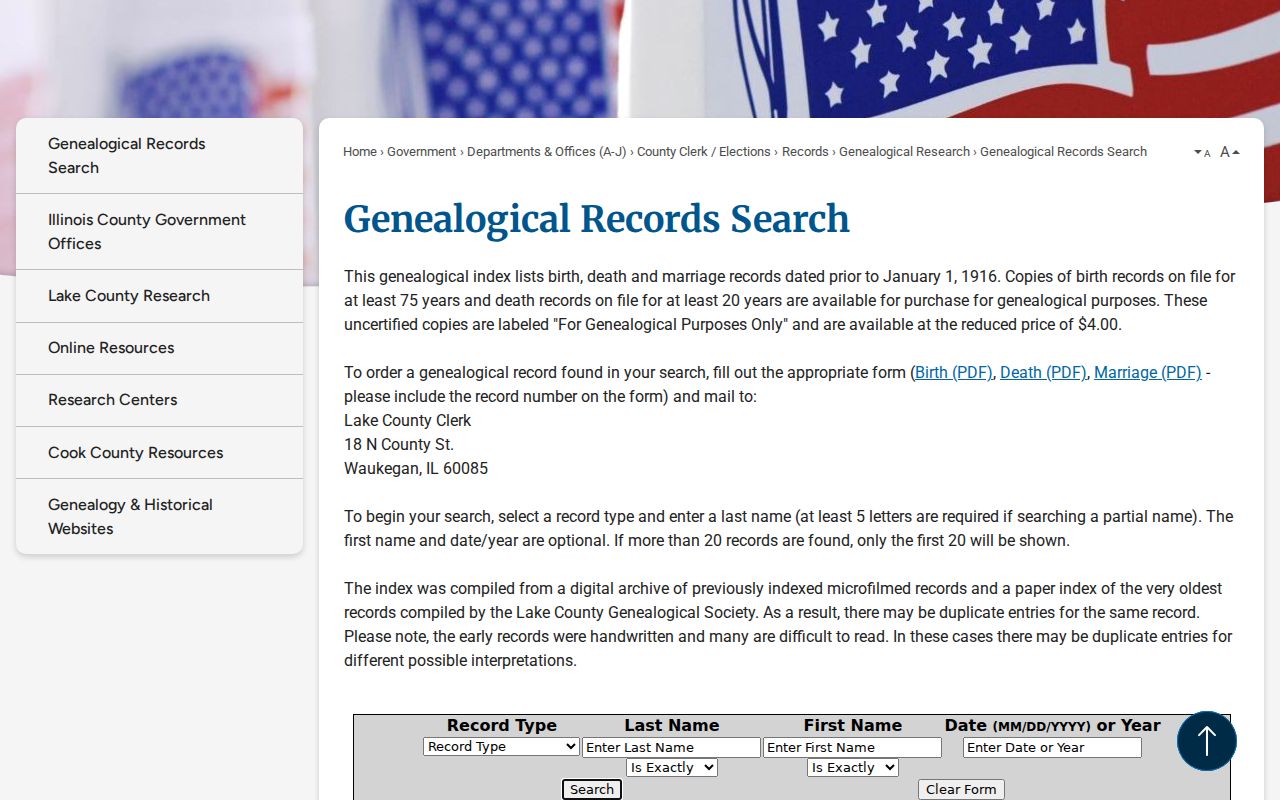
Its county indexes can corroborate a dated family event, while certified and genealogy copies remain subject to age and eligibility rules.
Record the uncertainty. A source may identify an owner, subscriber, or household on one date. It should not be stretched into an unsupported claim of continuous residence.